
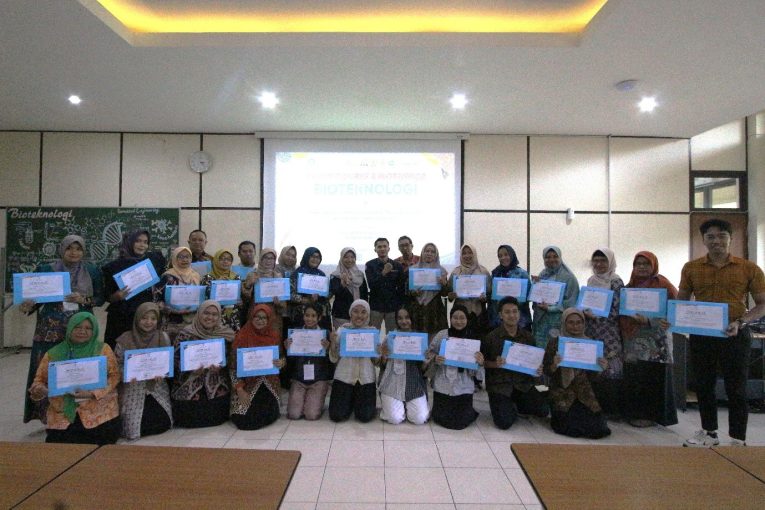
The Master’s Program in Biotechnology at Universitas Gadjah Mada (UGM) once again organized a Community Service Program as part of its ongoing commitment to supporting the professional development of educators in Indonesia. Carrying the theme “Know Your Food, Protect Your Generation: Biotechnology Education for Safe and Nutritious Food,” the program was held on August 4–5, 2026, at the Biotechnology Study Program Lecture Hall, PAU Building, UGM, Sleman.
The training brought together high school Biology teachers from various regions, including the Special Region of Yogyakarta, Magelang, Purworejo, Klaten, and Surakarta. Over the course of two days, participants engaged in both theoretical sessions and hands-on laboratory activities designed to deepen their understanding of food safety and the application of biotechnology in everyday life as well as in classroom learning.
Food safety served as the central focus of the program. As public awareness of food quality and safety continues to grow, understanding the sources of food contamination, methods of prevention, and techniques for identifying microorganisms has become increasingly important. Teachers play a crucial role in transferring this knowledge to students, helping to cultivate awareness of safe, healthy, and nutritious food from an early age.
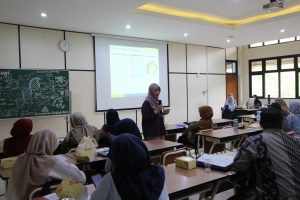
The training began with a session on Food Microbiology Techniques delivered by Dr. Dian Anggraini Suroto, S.T.P., M.T.P., M.Eng. Participants learned the fundamental principles of food microbiology, aseptic laboratory techniques, and laboratory safety procedures required for testing microorganisms in food samples. Through practical exercises, they gained firsthand experience in understanding how microorganisms can influence food quality and safety.
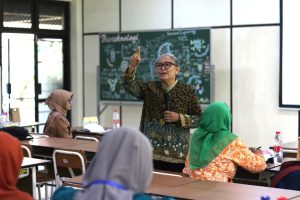
The discussion on food safety was further enriched through a session led by Prof. Dr. Ir. Endang Sutriswati Rahayu, M.S. Participants explored various sources of food contamination, key principles of hygiene and sanitation, and indicators commonly used to assess food cleanliness and safety. The session provided valuable insights that can help teachers educate students about making informed and healthy food choices.
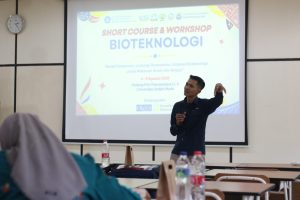
Participants were also introduced to modern biotechnology approaches through a Molecular Detection session presented by Ahmad Suparmin, S.P., M.AgrSc., Ph.D. The session included practical training in DNA isolation, colony PCR, and gel electrophoresis as molecular techniques for microorganism identification. These methods are widely used in many fields today, including food safety testing, where rapid and accurate microbial detection is essential.
Dr. Dini Wahyu Kartika Sari, S.Pi., M.Si., Head of UGM’s Master’s Program in Biotechnology, explained that the activity is part of a community engagement initiative regularly organized by the Master’s and Doctoral Programs in Biotechnology.
“For the past three years, high school Biology teachers have been one of the main groups we actively involve in our community service programs. We chose teachers because biotechnology is part of the high school curriculum, while opportunities to gain direct laboratory experience are not always available to every teacher,” she said.
Dini also expressed her hope that the program would generate long-term benefits for education. The knowledge and skills gained during the training are expected to be incorporated into classroom instruction, laboratory activities, and school canteen monitoring programs.
Through this initiative, UGM’s Master’s Program in Biotechnology aims not only to enhance teachers’ competencies in food safety and biotechnology but also to strengthen collaboration between higher education institutions and the educational community. This partnership is expected to contribute to greater scientific literacy while fostering a generation that is more aware of the importance of safe, healthy, and nutritious food.
***
Olivia Puja Ariyanti